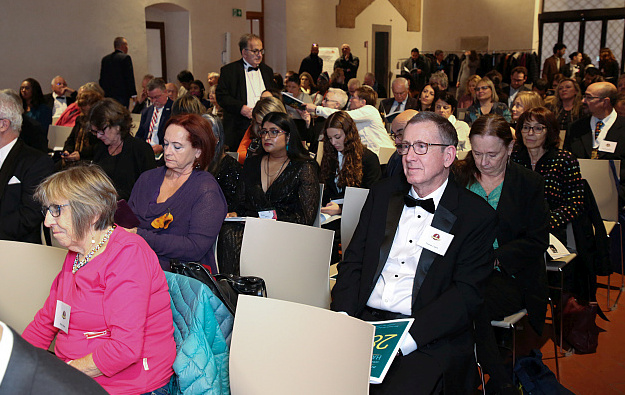
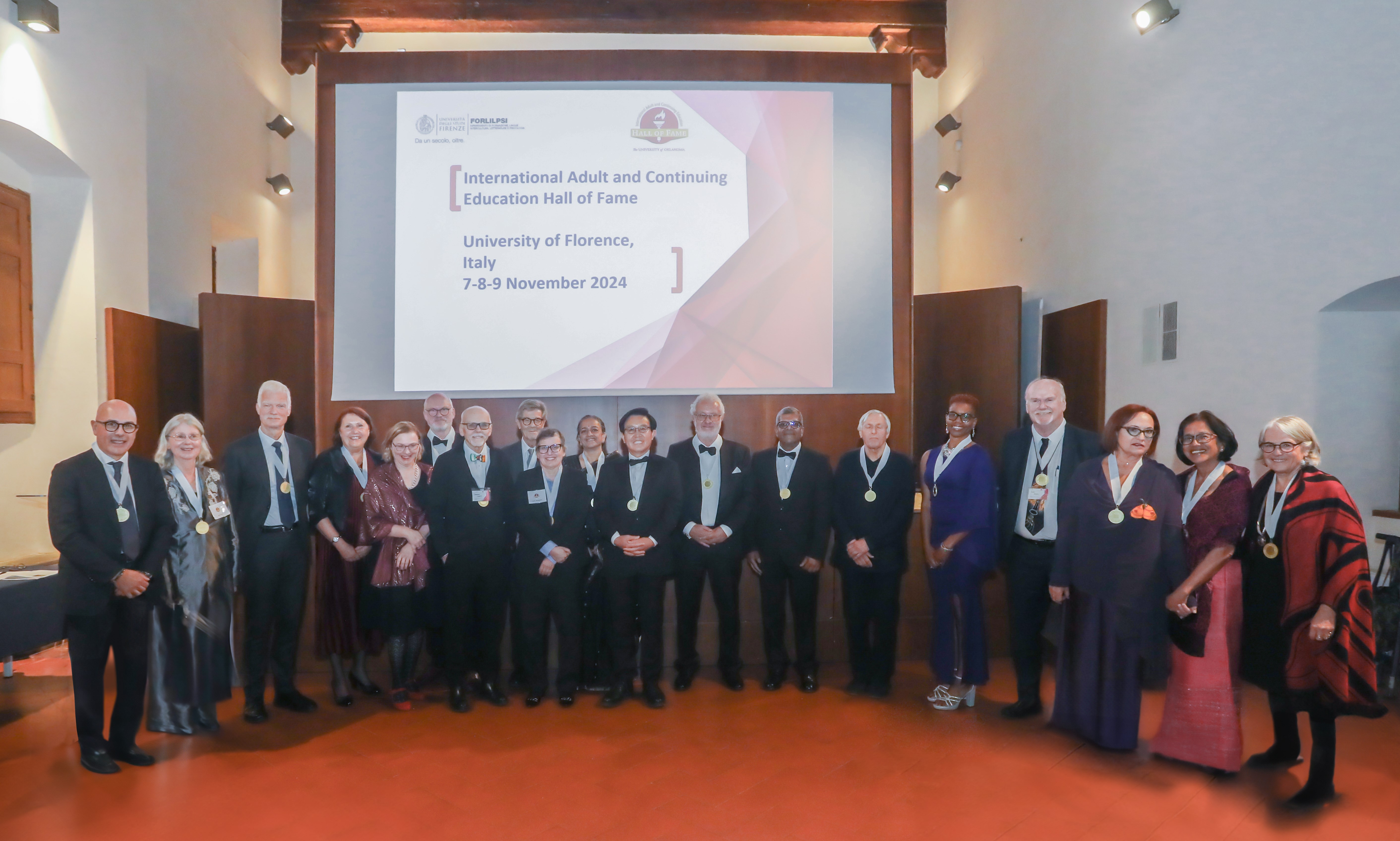
The 2024 Conference and Induction of the International Adult and Continuing Education Hall of Fame (IACE Hall of Fame), entitled “Revitalising Adult Continuing Education for Positive Social Changes and Personal Fulfilment: Meeting for Co-Creating New Partnerships and Projects,” was organised by the Hall of Fame European Chapter (HOFE) and hosted by the University of Florence, Italy. Paolo Federighi (HOF2019), Éva Farkas (HOF2019), and Arne Carlsen (HOF2017) served as Conference Chairs.
The Conference brought together approximately 150 participants from 26 countries, with the support of 22 adult education organisations and 15 international journals as partners. A central feature of the Conference was the establishment of ten international Working Groups (WGs), each intended to transform the discussions in Florence into new partnerships, research initiatives, publications and collaborative projects.
WG 10:Cooperation and stakeholder engagement for ALE
The follow-up activities demonstrate that the Conference has had an impact well beyond the event itself. Most Working Groups have continued their work through webinars, research collaborations, publications, networks and institutional partnerships. The developments reported below provide evidence of an emerging pattern: discussion in Florence has led to continuing collaboration, which in turn has generated concrete outputs and new international initiatives.
Preparation and Institutional Follow-up
In preparation for the Florence Conference, a special issue of the open-access journal Form@re (Vol. 24, No. 2, 2024 ), entitled “Revitalising Adult Continuing Education for Positive Social Changes and Personal Fulfilment,” was published. The guest editors were Èva Farkas, Que Anh Dang and Francesca Torlone, while Paolo Federighi serves as Editor-in-Chief.
An important institutional outcome of the Conference has been the signing of a Memorandum of Understanding (MoU) between the Hall of Fame and the University of Florence. The MoU provides a foundation for future cooperation. Among other commitments, the University of Florence will develop and host a new website for HOFE, establish a small HOFE secretariat, support selected follow-up activities of the Working Groups, and serve as the secretariat for the proposed Club of Florence.
The Conference also concluded with a proposal to establish a think tank under the name:
Club of Florence: Learning Unlimited – A New Renaissance for Lifelong Learning The proposed initiative seeks to contribute to a paradigm shift in lifelong learning in response to major contemporary challenges, including artificial intelligence, climate change, sustainable development, the changing lifelong-learning ecosystem, and the complementary roles of the public and private sectors.
Follow-up of the Ten Working Groups
Working Group 1: Marrakech Framework for Action -“ Towards an Inclusive Data Collection Process
Working Group 1 focused on the Marrakech Framework for Action and, in particular, the "Global Report on Adult Learning and Education" (GRALE).
The Working Group created opportunities for Hall of Fame members and other participants to connect with colleagues at the UNESCO Institute for Lifelong Learning (UIL). As a result of this networking, Lillian Hill (HOF2018) and Simone Conceição (HOF2018) were invited to contribute to the writing team for GRALE VI. They subsequently spent time at UIL in Hamburg in 2026 for a writing retreat.
The Working Group therefore provides an example of how the Florence Conference contributed to connecting members of the Hall of Fame with major international research and policy processes in adult learning and education.
Panel
· Chair: Isabell Kempf, UNESCO Institute for Lifelong Learning
· Nicolas Jonas, UNESCO Institute for Lifelong Learning
· Discussant: Uwe Gartenschläger (HOF2023), DVV International, Germany
· Hall of Fame Mentor: Arne Carlsen, Denmark
Working Group 2: University Lifelong Learning and Inter-University Partnerships
Working Group 2 has generated several continuing activities concerning the role of higher education in adult learning and education.
A significant outcome was PIMA Bulletin No. 53 (August 2025), a special issue entitled Higher Education Supporting Adult Learning and Education, edited by Heribert Hinzen (HOF2006) and Balázs Németh (HOF2017). The editors explicitly acknowledge the inspiration provided by the discussions of Working Group 2.
The themes discussed in the Working Group have also been taken forward in teaching at the Adult Education Academy, headed by Regina Egetenmayer (HOF2019) at the University of Würzburg, particularly in relation to professionalisation, community learning and learning cities.
A webinar involving eucen and PIMA was also organised, with the participation of Larissa Jogi (HOF 2022).
In addition, A SYMPOSIUM on “Academic Freedom and Democracy,” with the Hall of Fame as a supporting partner and involving Maria Slowey (HOF2015) and Michael Osborne (HOF 2022), is scheduled to take place at the University of Florence on 22–23 October 2026. A related Form@re special issue is planned for 2027.
Panel
· Chair: Pascal Pachoud, EUCEN
· Discussant: Balázs Németh, PASCAL International Observatory, Hall of Fame Member
· Discussant: Heribert Hinzen, PIMA
· Hall of Fame Mentor: Simone Conceição, University of Wisconsin–Milwaukee, United States
Working Group 3: Adult Learning and Education in Immigrant Settlement and Integration
Working Group 3 has developed particularly strong links with an ongoing international research partnership on Adult Learning and Education in Immigrant Settlement and Integration (ALE-in-ISI).
The initiative emerged partly from a Canadian-funded partnership development grant involving the University of British Columbia and the German Institute for Adult Education (DIE) in Bonn. The three-year project examines policies relating to adult learning and immigrant settlement and integration, quantitative dimensions of integration, and comparative studies in Canada and Germany.
The partnership has developed into a productive transatlantic collaboration involving research and conference presentations. The DIE colleagues who participated in Working Group 3 have remained active partners.
The project has also established an ALE-in-ISI Speakers Series, to which participants in the Florence Working Group were invited. One recent contribution was made by Vaughn John, a Working Group 3 participant, who discussed his work with immigrants in South Africa, including peace education activities involving people from conflict-affected countries.
An ALE-in-ISI Dialogue Network has also been established and remains open to researchers and others interested in the topic. The network has Canadian and German subgroups and periodically organises sessions involving the wider membership.
Although no Working Group 3-specific publication has yet been identified, the Florence Conference has contributed to maintaining an active international research community around adult learning, migration, settlement and integration.
Panel
· Chair: Thomas J. Sork (HOF2008), University of British Columbia, Canada
· Discussant: Alexandra Ioannidou, German Institute for Adult Education, Germany
· Hall of Fame Mentor: Simona Sava (HOF2017), West University of Timiºoara, Romania
Working Group 4: Understanding and Integrating Adult Learning Principles into Learning Settings and the Professionalisation of the Field
No substantial new follow-up activities have been reported at this stage.
The Working Group remains an area in which future collaboration and project development may be pursued.
Panel
· Chair: Sharon Bonney, COABE, United States
· Discussant: Shaketta D. Thomas, COABE, United States
· Discussant: Don Finn, COABE, United States
· Hall of Fame Mentor: André Schläfli (HOF2011), Switzerland
Working Group 5: Micro-credentials and Individual Learning Accounts
Working Group 5 has generated follow-up activities concerning skills frameworks, micro-credentials and the development of more transparent approaches to adult learning outcomes.
A major outcome is a forthcoming special issue of the Journal of Adult and Continuing Education, entitled “Skills Frameworks for Adult and Continuing Education: Learning Outcomes Transparency or Engineering Compliance?” The guest editors are Jens Bjørnåvold, Paolo Federighi and Johnny Sung, and publication is scheduled for April 2027. The call for papers remains open till 30 September 2026.
In addition, a project proposal concerning micro-credentials and Individual Learning Accounts has been developed for Erasmus+ cooperation, involving partners from Norway, Italy, Germany, Poland and Spain.
These activities demonstrate the continuation of Working Group 5's discussions into both academic publishing and European project development.
Panel
• Chair: Viola Pinzi, European Association for the Education of Adults, Belgium
• Discussant: Antra Carlsen, Nordic Network for Adult Learning, Denmark
• Discussant: Paolo Federighi, University of Florence, Italy
• Discussant: Kent Gudmundsen, Norwegian Competence Association – Kompetanseforbundet, Norway
• Hall of Fame Mentor: Sturla Bjerkaker (HOF2014), Norway
Working Group 6: Learning Cities
Working Group 6 has generated one of the most extensive portfolios of follow-up activities. Its impact can be seen across research and evaluation, city-to-city cooperation, international networking, UNESCO engagement, local dissemination and new policy-oriented research.
From discussion to evaluation and policy development
One of the most significant outcomes has been the review undertaken by Paolo Federighi and Arne Carlsen of Italian UNESCO Learning Cities. The resulting report, “Governance in Learning Cities in Italy: Evaluation Report,” was presented to the involved City Councils at a seminar organised by the City Council of Lucca in April 2026.
The work will receive further international dissemination at the 20th PASCAL Observatory Conference, “Flourishing Learning City Ecosystems for Creative Circular Economies,” hosted by the University of Pécs in collaboration with the Municipality of Pécs and partner organisations, including PIMA, ASEM LLL Network 6, IACEHOF Working Group 6, EPALE Hungary and PEACE, on 24–25 September 2026. Arne Carlsen will present the Italian experience in a keynote, while Balázs Németh and Michael Osborne are participating in the submissions panel.
Building a North American–European Learning Cities Network
A further development arising from the Working Group has been an initiative led by Cork Learning City to establish a North American–European Network of Learning Cities. The initiative builds on earlier meetings, including the first Forum hosted by Évry-Courcouronnes Learning City in September 2025 and a hybrid meeting hosted during the Cork Lifelong Learning Festival in April 2026.
Cork Learning City, working with Évry-Courcouronnes Learning City and with support from UNESCO's Institute for Lifelong Learning, has proposed developing a Charter for Mayors of Learning Cities in the European and North American Region. The proposed Charter is intended to provide a foundation for cities wishing to participate in a new sub-network of the UNESCO Global Network of Learning Cities.
The Cork–Lowell Partnership
A particularly concrete outcome has been the partnership between Cork, Ireland, and Lowell, Massachusetts. On 8 May 2026, Lowell, the first US member of the UNESCO Global Network of Learning Cities, signed a Learning Cities partnership and Memorandum of Understanding with Cork.
The Cork delegation, consisting of Lord Mayor Fergal Dennehy and Denis Barrett, Cork City Council's Learning City Coordinator and a member of Working Group 6, spent two and a half days in Lowell visiting local community programmes and exploring practical approaches to lifelong learning.
Lowell and Edmonton, another North American Learning City, have also begun discussions concerning future collaboration.
Local Dissemination and Connected Learning
The Working Group's influence has also extended into local learning ecosystems. Annalisa Raymer, Chair of Working Group 6, introduced the Learning Cities concept and network to the local Connected Learning Ecosystem (CLE) through a presentation in June 2026.
A further presentation is planned for a Climate Resource Fair in autumn 2026. These activities broaden the Learning Cities agenda by connecting lifelong learning with community development, connected learning and climate-related initiatives.
Arne Carlsen and Raul Valdes-Cotera promoted the work in a panel entitled l’UNESCO a Fumane at the Apprendi Festival in early September 2026 in Fumane, Italy.
Teachers as Lifelong Learners
The relationships developed through Working Group 6 have also generated new research cooperation. Annalisa Raymer and Aaron Benavot (HOF2023) met through the Working Group, and this connection subsequently developed into a UIL-sponsored project on Teachers as Lifelong Learners. The project involves Aaron Benavot, two colleagues and Annalisa Raymer and will produce a report containing monitoring guidelines for governmental and non-governmental entities, including cities. The report will bring together relevant literature and data sources and is expected to provide the basis for proposed monitoring guidelines. A draft is expected in late October 2026.
Strengthening Links with UNESCO and GRALE
Another important outcome has been the strengthening of connections with UNESCO's Institute for Lifelong Learning.
A contact shared by Aaron Benavot with Margaret Shanahan, and subsequently with Annalisa Raymer, helped facilitate US participation in the UIL Global Report on Adult Learning and Education (GRALE VI).
In July 2026, Working Group 6 members Simone Conceição and Lilian Hill went to UIL to contribute to the GRALE VI process. Their involvement illustrates how the Working Group has connected Hall of Fame members with wider international policy and reporting processes.
Academic Dissemination
Working Group 6 has also resulted in a substantial academic publication.
A special issue of Form@re, Volume 26, No. 1 (2026), entitled “Evaluating the Experience and Impact of Learning Cities. From Reporting to Transformative Capacity: Criteria, Evidence, Comparability,” has been published with Arne Carlsen, Raul Valdes-Cotera (HOF 2022) and Piergiuseppe Ellerani serving as guest editors. The issue provides a scholarly platform for examining how Learning Cities can be evaluated, compared and understood in terms of their transformative capacity.
Overall Significance of Working Group 6
Working Group 6 demonstrates particularly clearly how the Florence Conference has generated continuing activity at multiple levels:
Research and knowledge production, through the Italian Learning Cities governance review and the Form@respecial issue.
Policy development, through engagement with City Councils and the project on Teachers as Lifelong Learners.
City-to-city cooperation, through the Cork–Lowell partnership and the emerging North American–European Learning Cities network.
International networking, through PASCAL, UNESCO/UIL, GRALE and other lifelong-learning networks.
Local dissemination, through Connected Learning Ecosystems and climate-related initiatives.
Institutional cooperation, bringing together Hall of Fame members, universities, municipalities and international organisations.
Working Group 6 therefore provides a strong example of the pathway from conference discussion to sustained collaboration, research, policy engagement and institutional action.
Panel
Chair: Annalisa Raymer, North American Alliance of Learning Cities (NAALC)
Chair: Margaret Shanahan, North American Alliance of Learning Cities (NAALC)
Discussant: Balázs Németh, Pécs Learning City, Hungar<
Hall of Fame Mentor: Arne Carlsen, Denmark
Working Group 7: Journal Cooperation
Working Group 7 remains at the feasibility-study stage.
The Working Group continues to explore possibilities for cooperation among journals in adult and continuing education and related fields. Further developments will depend on the outcome of the feasibility discussions. 22nd of October 2026 there will be a meeting among JACE and FORM@RE to evaluate the sustainability issues.
Panel
Chair: Bonnie Slade, Journal of Adult and Continuing Education, United Kingdom
Discussant: Simona Sava, Journal of Educational Sciences, Romania
Hall of Fame Mentor: Paolo Federighi, Form@re Journal, University of Florence, Italy
Working Group 8: Gender Equity, Leadership and Ageing
Working Group 8 has progressed towards a more formal structure.
A formal institutional network has been established, and a work plan of activity has been discussed. An international initiative is currently envisaged for 2028. This development provides a basis for longer-term cooperation around gender equity, leadership and ageing in adult and continuing education.
Panel
Chair, Gender Equity and Leadership: Francesca Torlone, University of Florence, Italy
Chair, Gender and Ageing: Vanna Boffo, University of Florence, Italy
Discussant: Malgosia Malec Rawinski, Stockholm University, Sweden
Discussant: Janet Poley (HOF2002), University of Nebraska, United States
Hall of Fame Mentor: Mary Alfred (HOF2016), United States
Working Group 9: Education and Social Action to Develop Bottom-up Countermeasures against Organised Crime
Working Group 9 has resulted in several follow-up activities connecting adult education, social action, prison education and community-based responses to organised crime.
Antra Carlsen, working with the Nordic Network for Lifelong Learning, interviewed members of the network in response to questions posed by Form@re and contributed a piece to the journal's editorial work.
The Working Group has also contributed to a special issue of Form@re (Vol. 25, No. 3, 2025), entitled “The Educational Dimension of Penal Execution Inside and Outside Prison Walls: Treatment Approaches between Annihilation and Rehabilitation of Incarcerated Individuals.” The issue was guest edited by Francesca Torlone, Antra Carlsen, Pierangelo Barone, Joseph Giormaina and Timothy Ireland (HOF2024).
Further activities include:
a plan to organise a seminar with UNESCO's Institute for Lifelong Learning;
a special issue of Form@re as an academic output; and implementation of an Erasmus+ project that has recently been approved, involving several EARLALL members.
A webinar is being promoted on non-formal activities in prison.
These developments extend the Working Group's concerns into continuing research, European cooperation and policy-oriented discussion.
Panel
Chair: Antra Carlsen, Nordic Network for Adult Learning, Denmark
Giovanni Esposito, Libera/Social Cooperative Macramé, Italy
Discussant: Elisa Orlando, Libera. Associazioni, nomi e numeri contro le mafie/Libera. Associations, Names and Numbers Against Mafias, Italy
Hall of Fame Mentor: Timothy Ireland, UNESCO Chair in Youth and Adult Education, Brazil
Working Group 10: Cooperation and Stakeholder Engagement for Adult Learning and Education
The main impact of the workshop was actually a closer cooperation between the organisations that ran the workshop (EAEA and EBSN), but also Judith Alamprese (one of the speakers) and both EAEA and EBSN. EAEA and EBSN have started working together on statements concerning PIAAC and research that the OECD has done as a follow-up. Judith was also a speaker at the EBSN conference earlier this year.
In November 2025 the European Association for the Education of Adults, the Coalition of Lifelong Learning Organizations, and the American Association for Adult and Continuing Education were delighted to host the webinar “Lifelong Learning Across Borders”. It explored how lifelong learning is perceived in the US and the EU, discussed the role of frameworks in Europe, and reflected on what connects and differentiates us in an increasingly challenging world for education.
More generally, the topic of cooperations and partnerships remains a key principle for the involved organisations as it is a horizontal priority in the work of all.
Panel
Chair: Gina Ebner (HOF2019), European Association for the Education of Adults, Austria
Discussant: Zvonka Pangerc Pahernik (HOF2024), Slovenian Institute for Adult Education, Slovenia
Hall of Fame Mentor: Alfredo Soeiro (HOF2006), University of Porto, Portugal
Preserving the Legacy of European Adult Education
The Florence Conference has also inspired a historical initiative aimed at preserving the intellectual and institutional memory of European adult education.
Arne Carlsen has conducted an interview series entitled “Preserving the Legacy of European Adult Education” with five European Hall of Fame inductees who played leading roles in the European Presidential Conferences on Adult Education during the 1990s.
The interviewees are: Ekkehard Nuissl, Sturla Bjerkaker, Alan Tuckett, Heribert Hinzen, Paolo Federighi
These conferences played an important role in shaping European Union lifelong-learning programmes. The interviews have been published through the HOFE website, with selected excerpts appearing in the Hall of Fame Newsletter.
The initiative contributes to preserving the institutional memory of European adult education and making the experiences of earlier generations of leaders available to future generations.
Overall Impact of the Florence 2024 Conference
The follow-up activities demonstrate that the Florence 2024 Conference has developed into a continuing platform for international cooperation rather than remaining a one-time event.
The ten Working Groups have produced different levels and forms of activity. Some have already generated publications, projects, partnerships and institutional outcomes, while others remain at the feasibility or development stage. Taken together, however, they show substantial continuation of the Conference's central objective: co-creating new partnerships and projects for the revitalisation of adult and continuing education.
The emerging pattern can be represented as: Florence 2024 →Working Groups → Networking → Partnerships → Research and Projects → Publications and Policy Engagement → New International Initiatives.
The impact is visible at several interconnected levels.
Research and Knowledge Production
New publications, special journal issues, research projects and reports have emerged from, or been strengthened through, the Working Groups.
Institutional Cooperation
The MoU between the Hall of Fame and the University of Florence provides a new institutional foundation for continued HOFE activity. Other partnerships have connected universities, municipalities, UNESCO/UIL, professional networks and civil-society organisations.
International Networking
The Working Groups have strengthened connections among Hall of Fame members and organisations such as UNESCO/UIL, PIMA, PASCAL, EUCEN, EARLALL and other adult-learning networks.
City and Community Cooperation
Working Group 6 demonstrates particularly clearly how international networking can lead to concrete cooperation between cities, including the Cork–Lowell partnership and the emerging North American–European Learning Cities network.
Policy Engagement
Several Working Groups have created links with international policy processes, including GRALE VI, UNESCO Learning Cities and work on Teachers as Lifelong Learners.
Preservation of Professional Memory
The “Preserving the Legacy of European Adult Education” interview series demonstrates another dimension of impact: maintaining and transmitting the history and institutional memory of European adult education.
Looking Ahead
The follow-up activities emerging from the Florence Conference demonstrate the value of an active International Adult and Continuing Education Hall of Fame as a catalyst for international cooperation. What began in Florence as ten Working Groups has developed into an expanding portfolio of:
research collaborations;
academic publications;
international webinars and seminars;
city-to-city partnerships;
European and international projects;
UNESCO and UIL cooperation;
policy and evaluation initiatives;
ournal cooperation;
nstitutional networks; and
initiatives for preserving the history and legacy of adult education.
The different Working Groups are progressing at different speeds. Some have already produced tangible outputs, while others are still developing their partnerships and agendas. This diversity is itself characteristic of a living international network.
The experience of the Florence Conference suggests that the Hall of Fame can play a role that extends beyond recognising outstanding achievements in adult and continuing education. By bringing experienced leaders, researchers, practitioners, institutions and networks together, it can also provide a space in which professional relationships develop into partnerships, partnerships into projects, and projects into new knowledge, policy initiatives and forms of international cooperation.
The Florence 2024 Conference has therefore established a foundation for continued collaboration and provides an important point of reference for the future development of the European Chapter and the wider International Adult and Continuing Education Hall of Fame.
This report is dated 20 September 2026 and will be continuously updated as further follow-up activities take place.
Paolo Federighi and Arne Carlsen
Co-Chairs, European Chapter
International Adult and Continuing Education Hall of Fame




 Homepage Hall of Fame - European Chapter
 top of page